Surveyor
Measure land, boundaries and construction sites to provide accurate spatial information for property and development projects.
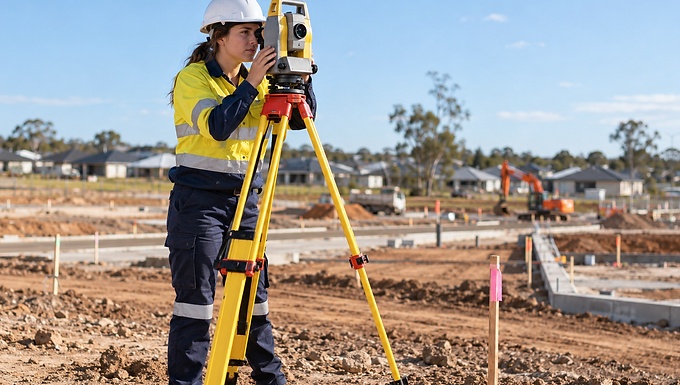
What They Do
Surveyors precisely measure the position, shape and boundaries of land and built environments.
They use technologies such as total stations, GNSS/GPS equipment, laser scanners, drones and specialised surveying software to collect spatial measurements.
Their work can include establishing property boundaries, preparing subdivision plans, setting out buildings and infrastructure, measuring construction progress and producing plans used by engineers, architects, developers and government authorities. JSA also identifies cadastral work, land subdivision, site plans and land-ownership documentation among surveying activities.
Who This Career Suits
Surveying suits people who enjoy a combination of technology, mathematics, property and outdoor work.
It can be particularly appealing to someone who doesn't want to spend every day behind a desk. Surveyors commonly divide their time between field measurements and analysing information in an office.
Accuracy is extremely important because surveying information can determine legal property boundaries and the exact position of major structures.
Key Skills
Measurement, Analytical Thinking, Attention to Detail, Mathematics, Technology, Problem Solving, Spatial Awareness, Communication
Work Environment
Outdoor, Construction Site, Office, Client Sites, Fieldwork
Education & Training
There are several levels of surveying work.
Vocational qualifications such as certificates, diplomas and advanced diplomas in surveying and spatial information can lead to roles such as Surveying Technician or Survey Assistant. A university surveying qualification is generally required to progress towards professional land or cadastral surveying registration.
Australian surveying degrees include programs at institutions such as RMIT, Curtin, UNSW, University of Southern Queensland and others. NSW's surveying regulator maintains a list of recognised Australian and New Zealand qualifications, illustrating the types of degrees accepted for professional registration.
Licensing rules vary by state and territory. For example, in Victoria a person wishing to perform cadastral surveying as a Licensed Surveyor must complete an approved surveying/geomatics degree, undertake supervised practical training and pass Board examinations.
Career Changer Pathway
Surveying can be accessible to career changers from construction, engineering, drafting, property, mining or other technical fields.
A person can begin through vocational surveying study and work as a Surveying Technician or Assistant while developing field experience.
Progression to a registered or licensed cadastral Surveyor generally requires an approved university qualification and the professional-registration requirements of the relevant state or territory.
Early Career
Graduate Surveyors commonly assist with field measurements, construction set-out, land surveys, data processing and preparation of plans.
They learn to operate sophisticated surveying equipment and work alongside experienced Surveyors while developing field accuracy and professional judgement.
Mid Career
Experienced Surveyors independently manage more complex surveys and may work directly with developers, engineers, architects and property owners.
They can specialise in areas including:
land surveying, cadastral surveying, construction surveying, engineering surveying, mining surveying or hydrographic surveying.
Senior / Veteran Career
Senior Surveyors may become Licensed or Registered Surveyors, Survey Managers, Project Surveyors or specialist consultants.
Experienced professionals can manage large infrastructure and development projects, supervise surveying teams or establish their own surveying businesses.
Salary Guide
Early Career
75000
Mid Career
105000
Senior / Veteran
140000
Indicative annual salary (AUD)
Indicative annual salary (AUD)
Indicative annual salary (AUD)
Salary data source:
Jobs and Skills Australia / ABS
Salary data source URL:
Date :
8 October 2026 at 12:00:00 am
Career Outlook
The occupation is closely linked to housing development, infrastructure, construction, mining and land administration. JSA reports about 18,500 Surveyors and Spatial Scientists, with annual employment growth of around 200.
More importantly, JSA's 2025 shortage analysis specifically lists Surveyor among professional occupations that remained in shortage nationally, even as a number of other engineering and professional occupations moved out of shortage.
Job Outlook :
Outlook Source :
Strong
Where do I go from here?
Explore Training
Find courses, qualifications and training pathways for this career.
Explore Jobs
See current opportunities and understand what employers are looking for.
Similar Careers
Discover other careers that use similar skills and interests.